Finding a reliable Jerash tour guide makes a significant difference when exploring one of the largest and best-preserved Roman provincial sites in the world. The ancient city of Gerasa covers a vast area with dozens of monuments, temples, colonnades, and theaters spread across uneven ground. We assist travelers in arranging a suitable private guide based on your language preferences, dates, group size, and planned route, subject to guide availability.
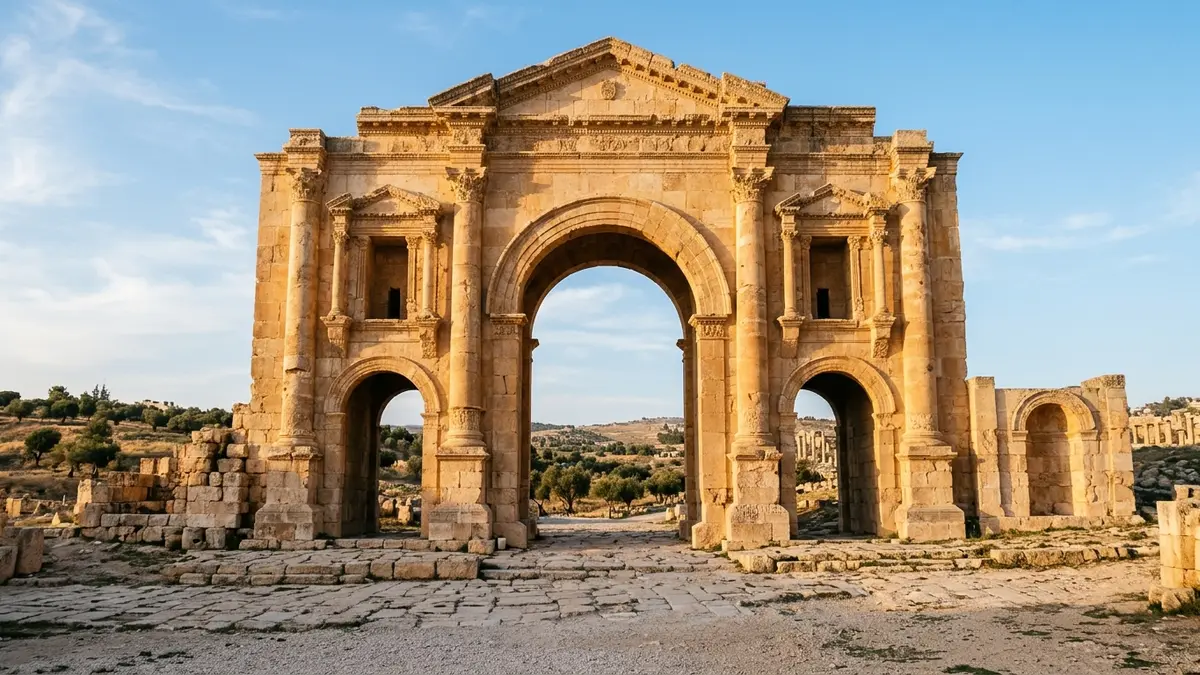
Why Jerash benefits from a guide: Jerash tour guide insights
The archaeological site of Jerash represents centuries of continuous human occupation. While many visitors recognize the iconic image of the Oval Plaza, the site contains layers of Greco-Roman, Byzantine, and early Islamic history that are not immediately obvious when walking through independently.
On-site signage at Jerash is sparse. Explanatory plaques exist at major structures, but they offer minimal context regarding how the city functioned daily, how engineering challenges were solved, or how urban planning shifted over six centuries. A private guide Jerash traveler relies on provides the historical framing necessary to transform scattered ruins into a clear picture of ancient city life.
When walking through the site, key architectural features often go unnoticed without commentary:
- Earthquake Engineering: Roman builders incorporated loose stone joints and specific mortar mixtures into high columns to absorb seismic activity. Your guide can demonstrate how standing columns at the Temple of Artemis still sway slightly during strong wind or under pressure without collapsing.
- Acoustic Design: The South Theater exhibits precise acoustic engineering. A person speaking at normal volume at the center of the stage can be heard clearly across all 3,000 stone seats.
- Water Management Systems: Underneath the stone paving of the main street lie carved drainage channels, stone inspection hatches, and ceramic piping systems that funneled rainwater and waste away from public spaces.
- Religious Transitions: Several buildings show clear architectural modifications where pagan temples were converted into Byzantine churches, followed by administrative reuses during the Umayyad period.
Understanding these details requires contextual knowledge. If you are planning a broader trip across the country, securing a private tour guide in Jordan helps maintain consistency in how history and culture are explained at each major destination.
For updated official site opening hours, visitor center procedures, and admission ticket details, refer directly to the official Visit Jordan Jerash guide.
Arranging a Jerash private tour allows you to move at your own pace, ask detailed historical questions, and adjust your walking route depending on heat and physical mobility.
The usual route through the site
A comprehensive walking tour through Jerash covers approximately two to three kilometers of continuous walking over uneven stone pavings, stairs, and dirt tracks. A structured guided tour Jerash itinerary typically follows a chronological and spatial sequence from south to north.
Standard Walking Sequence
- Hadrian’s Arch: Built to honor the visit of Emperor Hadrian in 129–130 CE. This monumental gateway stands outside the primary city walls and serves as the entry point to the southern archaeological zone.
- The Hippodrome: An ancient arena measuring over 245 meters in length. It was used primarily for chariot racing and athletic competitions, holding up to 15,000 spectators.
- The South Gate: The original southern entrance through the city’s defensive wall, constructed in the 2nd century CE.
- The Oval Plaza (Forum): An unusual asymmetrical plaza measuring 90 by 80 meters, paved with high-quality limestone slabs and enclosed by 56 ionic columns. It links the main street to the Temple of Zeus.
- The Temple of Zeus and South Theater: Perched on a hill overlooking the Oval Plaza. The South Theater was constructed during the reign of Emperor Domitian and remains the largest theater at the site.
- The Cardo Maximus: The primary north-south colonnaded street stretching 800 meters. Look closely at the paving stones to spot grooves worn into the rock by ancient chariot wheels, as well as access covers for underground drainage.
- The Agora and Nymphaeum: The commercial market area followed by the main public fountain. The Nymphaeum is a two-story ornamental fountain decorated with carved stone heads and marble basins.
- The Temple of Artemis: The grandest temple complex in Gerasa, dedicated to the patron goddess of the city. High Corinthian columns dominate the central courtyard.
- The North Theater and North Gate: A smaller, intimate theater used for city council meetings and performances, situated near the northern end of the Cardo.
- The Byzantine Churches Complex: Located behind the main Roman structures. These 5th and 6th-century structures contain preserved floor mosaics featuring geometric patterns and animal depictions.
| Site Section | Key Architectural Focus | Average Time Needed | Walking Terrain |
|---|---|---|---|
| Hadrian’s Arch & Hippodrome | Triumphal arches, athletic arena | 20–30 minutes | Flat gravel, open sun |
| Oval Plaza & South Theater | Ionic colonnades, acoustic stage | 40–50 minutes | Stone paving, moderate stairs |
| Cardo Maximus & Nymphaeum | Corinthian columns, water fountains | 45–60 minutes | Uneven Roman cobbles |
| Temple of Artemis | Monolithic columns, elevated cella | 30–40 minutes | Steep stone staircases |
| Byzantine Churches | Mosaic pavements, basilical layouts | 30 minutes | Flat dirt paths, covered areas |
Hiring a private tour guide Jerash travelers count on ensures you navigate this extensive layout efficiently without backtracking or missing key elevated points like the mosaic floors near the Church of St. Cosmas and Damian.
Do you need a guide in Jerash?
A common query from independent travelers is: do you need a guide in Jerash? The straightforward answer is no, a guide is not mandatory by law to enter or explore the site. Visitors can purchase entry tickets at the visitor center and explore the ruins entirely on their own.
However, deciding whether to explore independently or hire a guide depends on your interest in classical history, your available time, and how much context you prefer during your visit.
Self-Guided Exploration
Walking through Jerash on your own offers total flexibility. You can spend extra time taking photos, rest in shade whenever necessary, or skip sections of the ruins that interest you less.
The downside of going unguided is the lack of information. Aside from high-level maps at the entrance, there are few detailed signs explaining what individual buildings were used for, how local society operated, or where specific historical events took place. Without background reading, many stone foundations can look identical.
Guided Exploration
Engaging a Jerash half day tour guide changes how you experience the site. A guide highlights small, overlooked details:
- Ancient board games carved into the steps of public buildings by waiting citizens.
- Early Christian symbols carved over pagan reliefs near temple doorways.
- Structural details explaining how water was raised from nearby springs to supply upper city fountains.
- Specific angles for photography that avoid heavy crowd congestion.
If you are requesting an English guide Jerash visitors can rely on, clear commentary helps bring the empty stone structures to life.
Before making a decision, reviewing overall travel expenses across your trip itinerary is recommended. Understanding tour guide cost structures throughout Jordan helps you allocate budget effectively across northern historical sites and southern natural reserves.
Amman Jerash private tour: Combining cities
Jerash is located approximately 48 kilometers north of Amman. Because of this proximity, an Amman Jerash private tour is one of the most common day-trip routes in northern Jordan. The driving time between downtown Amman and the Jerash visitor center is usually about 45 to 60 minutes, depending on urban traffic conditions leaving the capital.
Recommended Day Structure
To make the most of a day trip combining both cities, start early in the morning:
- 08:00 – 09:00: Travel from Amman to Jerash.
- 09:00 – 12:00: Guided walking tour of Jerash ancient city while temperatures are moderate and light is optimal for photos.
- 12:00 – 13:00: Lunch break near the modern town of Jerash or along the return route.
- 13:00 – 14:00: Return drive to Amman.
- 14:00 – 17:00: Afternoon exploration of Amman’s historical center, including the Citadel (Jabal al-Qal’a) and the Roman Theater.
An Amman Jerash tour guide can seamlessly connect the historical timeline between the two locations. Modern Amman stands over ancient Philadelphia, which, like Gerasa, was a member of the Decapolis—a league of ten Hellenistic-Roman cities on the eastern frontier of the Roman Empire. Visiting both sites in a single day clearly illustrates how Roman urban planners used similar defensive, civic, and religious layouts across the region.
If you plan to divide your days between the capital and northern ruins, coordinating with an Amman tour guide for your afternoon city walk ensures you do not repeat historical background already covered in the morning at Jerash.
Hotel pickup in Amman, transport with a driver to Jerash and back, and airport pickup can all be arranged — just mention your hotel area and plan in your message.
Adding Ajloun or Umm Qais to a Jerash tour
Many travelers choose to expand a half-day excursion to Jerash into a full day trip across northern Jordan. The two most practical additions are Ajloun Castle or the Greco-Roman ruins of Umm Qais.
Option 1: Jerash and Ajloun Castle
Ajloun Castle (Qal’at Ar-Rabad) is situated approximately 20 kilometers west of Jerash, high in the hills of the Ajloun region. The drive between the two sites takes roughly 30 minutes through olive groves and pine forests.
- Historical Contrast: While Jerash displays classical Roman and Byzantine civic architecture, Ajloun is a medieval Islamic military fortress. It was constructed in 1184 CE under the direction of Izz al-Din Usama, a nephew of Saladin, to guard local iron mines and secure trade routes against Crusader expansion.
- Site Features: The fortress features thick stone defensive walls, dry moats, drawbridge structures, internal stairways, and high towers offering views across the Jordan Valley.
- Time Required: A thorough walk through Ajloun Castle takes between 1 and 1.5 hours.
Option 2: Jerash and Umm Qais (Gadara)
Umm Qais lies approximately 65 kilometers north of Jerash, near Jordan’s northern border. The drive takes about 1 hour and 15 minutes.
- Unique Features: Built largely from dark black basalt stone, Umm Qais presents a striking visual contrast to the pale limestone of Jerash. It offers broad views over the Sea of Galilee, the Golan Heights, and the Yarmouk River gorge.
- Key Sights: A Roman theater built of black basalt, a colonnaded street, ancient vaulted shops, and an Ottoman-era village constructed directly on top of classical ruins.
- Time Required: Exploring the main archaeological sector of Umm Qais requires about 1.5 to 2 hours.
Comparing Northern Itinerary Options
- Jerash Only (Half Day): Best for travelers with limited time or those who prefer a relaxed pace without long hours in transit.
- Jerash + Ajloun (Full Day): Ideal for visitors wanting a contrast between classical Roman antiquities and medieval Islamic fortifications without excessive driving.
- Jerash + Ajloun + Umm Qais (Long Full Day): Best suited for dedicated history enthusiasts comfortable with a full day on the road covering multiple geographical zones.
For ideas on how to fit these northern sights into a comprehensive travel schedule across the country, review our suggested 5-day itinerary model.
Visiting Jerash with kids
Jerash is an engaging site for families travelling with children, offering large open areas, dramatic ancient structures, and plenty of room to walk outdoors. However, navigating an ancient archaeological site with children requires some practical preparation.
Practical Tips for Families
- Strollers vs. Baby Carriers: Avoid pushing lightweight strollers or pushchairs inside the main archaeological zone. The Cardo Maximus and Oval Plaza are paved with uneven, ancient Roman stones with deep gaps, high curbs, and frequent stone steps. A framed child carrier backpack or sturdy wrap is far more practical for toddlers and infants.
- Sun Protection and Shade: Shade is scarce along the main colonnaded streets and inside the open plazas. Bring broad-brimmed hats, high-SPF sun cream, and sufficient drinking water for each family member.
- Footwear: Ensure children wear closed-toe walking shoes or sturdy sports sandals with good grip. Dust, loose gravel, and smooth, worn limestone steps can be slippery.
- Interactive Learning Points: Children often enjoy specific features of Jerash, such as testing the acoustics at the center stage of the South Theater, observing how ancient stonemasons carved decorative motifs, or seeing where ancient chariot wheels wore grooves into the road paving.
A private guide can adapt the pace of the walk, keeping commentary engaging for younger travelers while pointing out safe pathways around step-heavy sections of the site.
How to request a guide
We are Jordan Tourism (jordantourism.net), an independent service that helps travelers arrange a suitable private guide tailored to their language preferences, dates, group size, and route, subject to guide availability. We are not an official government body, an online self-booking engine, or a public directory of named individuals.
Request Process
To arrange a private guide for your visit to Jerash or a broader northern itinerary, contact us via WhatsApp or phone with the following information:
- Preferred Language: Specify if you require an English guide or another language.
- Travel Dates: Provide your exact intended date of visit.
- Group Size: Indicate the number of adults and children in your party.
- Planned Route: Let us know if you want a half-day tour focused solely on Jerash, or a combined itinerary including Amman, Ajloun, or Umm Qais.
- Starting Point: State where you will be traveling from (e.g., an Amman hotel, Queen Alia International Airport, or arriving directly at Jerash).
Once we receive your details, we check availability among qualified local guides who match your criteria and communicate available options directly to you.
We encourage all travelers to ask guides about their professional credentials and verify licensing standards with official tourism authorities upon arrival if desired.
Hotel pickup in Amman, transport with a driver to Jerash and back, and airport pickup can all be arranged — just mention your hotel area and plan in your message.
FAQ
How long do you need in Jerash?
Most visitors spend between two and three hours exploring the main ruins of Jerash. This duration allows enough time to walk the main axis from Hadrian’s Arch up to the Temple of Artemis, visit both theaters, and see the Oval Plaza without rushing. If you have a deep interest in ancient history or wish to view the Byzantine mosaic floors in detail, plan for up to four hours.
Is Jerash worth a guide?
Hiring a guide at Jerash adds substantial context to what you are seeing. Because on-site explanatory signs are limited, a guide points out architectural nuances, acoustic designs, and historical context that are easily missed when walking through independently. It is particularly helpful if you want to understand Roman civic engineering or the site’s transition from classical paganism to Christianity.
Can you do Amman and Jerash in one day?
Yes, combining Amman and Jerash in a single day is standard practice for many visitors. Jerash is roughly a 45 to 60-minute drive from central Amman. A typical day trip involves spending the morning at Jerash, taking a short lunch break, and returning to Amman in the afternoon to visit the Citadel and the Roman Theater.
Is Jerash good for kids?
Jerash is a great destination for children because it offers large open spaces and impressive structures like big theaters and high columns. However, the terrain is uneven, with rough stone paving and high steps. Strollers are difficult to push across the Roman stones, so baby carriers are recommended for younger children, along with proper sun protection and plenty of water.
Can I request an English guide for Jerash on short notice?
You can request an English guide on short notice, but availability depends on the time of year and overall visitor demand. During peak travel seasons in spring and autumn, guides are often booked well in advance. Sending your travel dates, group size, and itinerary details as early as possible increases the likelihood of securing a guide for your preferred time.
Is a guide mandatory to enter the Jerash archaeological site?
No, a guide is not mandatory to enter or walk around the ancient city of Jerash. Visitors can purchase standard admission tickets at the visitor center and tour the site independently. Hiring a private guide is entirely optional and based on your personal travel preferences.
What details should I provide when requesting a Jerash private tour guide?
When reaching out to us, provide your desired tour date, the total number of people in your party, your preferred language, your starting location, and any additional sites you plan to visit on the same day, such as Ajloun Castle or downtown Amman. This helps us quickly evaluate availability and respond with options that match your plans.
Need a Private Guide in Jordan?
Send us these details on WhatsApp to check availability and pricing:
- Preferred language
- Travel dates
- Number of travelers
- Planned route
- Hotel or flight arrival