Arranging a private guide Petra helps you navigate the extensive archaeological park efficiently and understand the Nabataean civilization behind the monuments. Whether you enter through the main visitor center or plan a broader journey across Jordan, an experienced guide provides context to carved facades, ancient water channels, and desert trails. We help travelers connect with available Petra tour guides licensed according to Jordanian requirements, tailored to their schedule, language preference, and physical pace.
What a private guide Petra adds to your visit
Petra covers over 260 square kilometers of mountainous desert, canyons, and carved sandstone monuments. While signs mark major paths, a tour guide Petra offers structural context, historical chronology, and route optimization that self-guided visitors often miss.
The ancient city was built by the Nabataeans, an Arab people who controlled trade routes for spices, incense, and silk over two thousand years ago. Without background explanation, many visitors view Petra simply as a collection of impressive rock faces. A Petra private guide explains how the Nabataeans engineered hydraulic systems to capture flash floods, how foreign architectural styles influenced local stone carvers, and how the city evolved through Roman and Byzantine periods.
Navigating the site effectively requires practical planning. The main basin gets crowded during peak hours when large tour groups arrive. A private guide for Petra helps you time your movement through narrow passages like the Siq, select quieter paths between major monuments, and adjust the itinerary based on weather and heat levels.
For readers evaluating whether to explore independently or hire assistance, review our guide on Do you need a guide in Petra? to understand site accessibility and walking demands.
| Aspect | Self-Guided Exploration | Exploration with a Private Petra Tour Guide |
|---|---|---|
| Historical Context | Limited to signage boards and general travel brochures. | Detailed explanation of Nabataean engineering, trade networks, and architectural evolution. |
| Navigation | Standard main trail reliance; potential to miss side tombs and elevation viewpoints. | Route tailored to energy levels, including alternative paths and quiet viewpoints. |
| Pacing & Timing | Risk of hitting peak crowd times at key locations like the Treasury. | Adjusted departure and route flow to minimize congestion and avoid mid-day sun exposure. |
| Site Logistics | Independent management of rest stops, water points, and cart arrangements. | Practical advice on local customs, resting points, terrain difficulty, and trail safety. |
The main route: Siq, Treasury, Street of Facades, Theatre, Royal Tombs, Colonnaded Street
The primary archaeological trail begins at the main entrance in Wadi Musa and extends through the central valley. A private tour guide Petra takes you along this core axis, which contains the site’s most famous monuments.
Bab as-Siq and the Obelisk Tomb
The walk starts outside the canyon at Bab as-Siq (Gate to the Siq). Here you encounter large free-standing stone blocks known as Djinn Blocks and the Obelisk Tomb, sitting above the Bab as-Siq Triclinium. A guide points out the distinct architectural elements combining Egyptian, Greek, and Nabataean influences carved into the rock face.
The Siq
The Siq is a natural geological fault formed by tectonic forces and worn smooth by water. Stretching roughly 1.2 kilometers, this narrow gorge features rock walls reaching over 90 meters high. As you walk through, a guide points out:
- Terracotta water pipes set into channels along the canyon walls.
- Votive niches and small carved shrines built by ancient merchants.
- Remaining sections of Roman paving stones beneath your feet.
- Natural stone formations showing mineral veins of pink, yellow, and red.
Al-Khazneh (The Treasury)
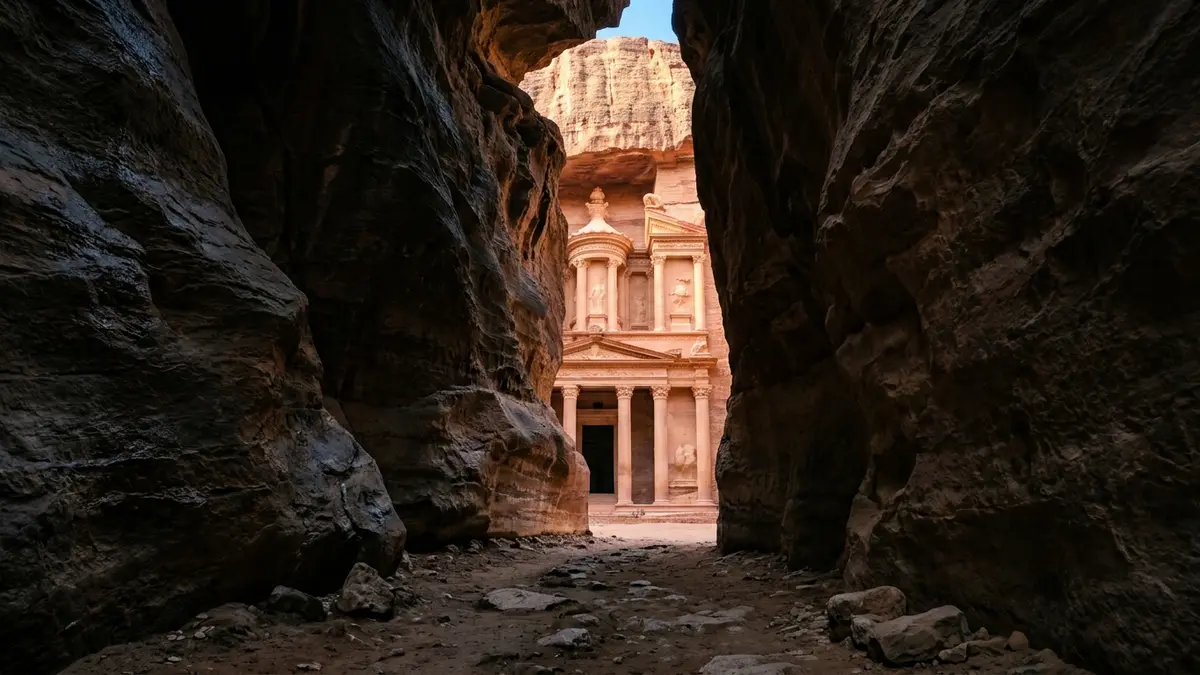
Emerging from the Siq reveals Al-Khazneh, or The Treasury. Carved directly into the sandstone cliff face in the first century BC, this 40-meter-high facade served as a royal tomb. Your guide will explain the architectural symmetry, the theories behind its classical Hellenistic carvings, and the distinction between popular legends and archaelogical findings.
Street of Facades and the Theatre
Past the Treasury, the canyon opens into the Outer Siq. The Street of Facades features dozens of Nabataean tombs cut high into the rock face. Further along sits the Theatre, carved directly into the mountain side. Modified during the Roman period, it once seated thousands of spectators. A guide explains how stonecutters sliced through older Nabataean tombs to expand the seating tiers.
The Royal Tombs
Elevated on the eastern cliff face, the Royal Tombs overlook the main valley. A guided tour Petra typically covers these impressive structures:
- Urn Tomb: Built with an expansive courtyard supported by vaulted stone arches, later converted into a Byzantine church.
- Silk Tomb: Named for its striking streaks of pink, yellow, and grey sandstone.
- Corinthian Tomb: Features architectural elements similar to the Treasury, weathered by wind and water.
- Palace Tomb: A five-story facade designed to mimic classical Roman palace architecture.
The Colonnaded Street and Qasr al-Bint
The main trail descends into the lower valley along the Colonnaded Street, built during Roman rule. You will pass the Nimphaeum, the Temenos Gate, and the ruins of major temples before reaching Qasr al-Bint, one of Petra’s few free-standing stone structures that survived historical earthquakes.
Going further: the Monastery and longer trails
Beyond the main valley floor lie steep mountain trails leading to secondary monuments and high viewpoints. Exploring these upper trails with a private Petra guide ensures you track time correctly and manage physical effort safely.
Ad Deir (The Monastery)
Ad Deir is one of the largest monuments in Petra, measuring 50 meters wide and 45 meters high. Reaching it requires climbing roughly 800 stone steps carved into the mountainside.
A full-day guide manages your ascent, ensuring regular rest breaks in shaded spots. Along the trail, you pass bedouin tea stalls and mountain vistas before reaching the plateau. The Monastery served as a Nabataean assembly hall and was later used as a Christian chapel, as shown by crosses carved on inside walls.
High Place of Sacrifice
This mountain-top sanctuary requires a steep climb up ancient rock stairs starting near the Theatre. The summit features two 6-meter obelisks carved directly out of the mountain ridge, an altar platform, and drainage channels used for ritual libations. A guide helps you descend via the back trail through Wadi Farasa, passing lesser-visited sites such as the Garden Tomb, the Roman Soldier Tomb, and the Lion Triclinium.
Al-Khubtha Trail
For views overlooking the Treasury from above, the Al-Khubtha trail climbs the cliffs behind the Royal Tombs. The path includes steep rock stairs and leads across flat rock plateaus to a cliff-edge viewpoint.
If you plan to incorporate Petra into a wider national itinerary, read about options for a Private tour guide in Jordan to coordinate guides across multiple regions.
Where guided visits usually start
Most guided walks begin directly at the Petra Visitor Center in Wadi Musa. This is where ticket check counters, luggage facilities, and official information desks are located.
Meeting points are usually flexible based on your travel setup:
- Petra Visitor Center: The standard starting location for almost all day visitors.
- Hotel Lobby in Wadi Musa: For travelers staying near the park entrance, a guide can meet you in your lobby and walk with you to the main gates.
- Little Petra (Siq al-Barid): If you are taking the secondary backdoor hike toward the Monastery, your start location will be outside the main town.
Depending on your plan and availability confirmed after your WhatsApp message or call, airport pickup (e.g. Queen Alia International Airport), hotel pickup and drop-off, and transport by car with a driver between sites can be arranged together with your guide.
For a clearer understanding of how transportation options integrate with guided visits, read our comparison on Guide vs driver options in Jordan. Evaluating the tour guide versus driver option will help you determine which combination fits your travel style best.
Half-day or full-day options with a Petra private guide
The time you dedicate to Petra depends on your overall travel schedule, physical endurance, and depth of interest in archaeology.
Petra Half-Day Guide (3 to 4 Hours)
A half-day arrangement focuses on the classic core path.
- Route: Visitor Center -> Bab as-Siq -> The Siq -> The Treasury -> Street of Facades -> Theatre -> Colonnaded Street / Qasr al-Bint.
- Walking Distance: Approximately 8 to 10 kilometers round trip on mostly flat or gently sloping ground.
- Best For: Travelers with limited time, families with young children, or those taking a afternoon transport to another destination like Wadi Rum or Amman.
Petra Full-Day Guide (6 to 8 Hours)
A full-day arrangement covers the main valley floor plus one or two upper mountain trails.
- Route: Includes the complete main trail, followed by the climb to Ad Deir (The Monastery) or the High Place of Sacrifice.
- Walking Distance: Approximately 14 to 18 kilometers with significant stair climbing.
- Best For: Hikers, photography enthusiasts, and visitors spending at least two nights in Wadi Musa.
A Petra day tour with private guide allows flexibility; if you feel tired midday, your guide can shorten upper trail routes and redirect focus toward valley monuments.
Petra with kids or older travelers
Exploring Petra involves walking over uneven ground, loose gravel, soft sand, and slick stone stairs. Summer heat can be intense, while winter days bring cool temperatures and rain.
For families traveling with children or older visitors, a private guide tailors the pace:
- Pacing Controls: Frequent stops in shaded canyon areas prevent fatigue.
- Mobility Options: Electric golf carts run between the Visitor Center and the Treasury for visitors with mobility limits. Cart tickets can be purchased at the main entrance.
- Terrain Advice: Guides identify paths with smoother walking surfaces, avoiding steep stone steps where necessary.
- Hydration and Rest: Recommending appropriate rest stops with shaded seating and proximity to clean restroom facilities.
When planning your group’s budget and structure, review details on Tour guide cost to understand how group sizes affect overall travel planning. To better plan your overall travel budget, review our detailed overview of Jordan tour guide expenses before finalizing your arrangements.
Guides in English and other languages
Clear communication makes a significant difference when exploring complex historical sites. Having an English speaking guide Petra ensures you can ask detailed questions about Nabataean culture, religion, and geology.
An English guide Petra can explain nuanced historical theories clearly. Beyond English, visitors often request assistance in other European languages. We assist in locating available guides for:
- German guide Petra requests.
- Spanish guide Petra requests.
- French guide Petra requests.
For travelers requiring Slavic language coverage across their trip, learn more about booking a Russian-speaking guide for itineraries covering Petra and northern sites. You can reserve a dedicated Russian-speaking guide to ensure complete understanding of the site’s rich heritage.
Requests for non-English guides should be submitted well in advance, particularly during peak spring (March–May) and autumn (September–November) travel seasons.
Day trip from Amman: realistic or rushed?
Traveling from Amman to Petra and returning in a single day is a common request for visitors with tight schedules. Understanding the distances helps set reasonable expectations.
The highway distance between Amman and Wadi Musa is roughly 230 kilometers via the Desert Highway, taking about 3 hours of direct driving each way. Via the scenic King’s Highway, driving times can exceed 4.5 hours.
Reality of an Amman to Petra Private Tour with Guide
- Total Time: 10 to 12 hours total commitment.
- Time inside Petra: 4 to 5 hours maximum walking time.
- Feasibility: A Petra day trip from Amman with guide works fine for seeing the main trail up to the Colonnaded Street or Royal Tombs. It does not allow enough time to hike to the Monastery without extreme exertion.
For multi-day Jordan trips that incorporate Petra smoothly, check our suggested 5-day itinerary for balanced pacing.
Tickets and what a guide does not include
Understanding ticket procedures ensures a smooth arrival at the gate.
Entrance tickets are sold directly by the park authorities at the main entrance or can be covered by the official Jordan Pass if purchased online prior to arrival. You can review official ticket rules and details on the official Petra Development and Tourism Region Authority site or read historical site summaries at the UNESCO World Heritage site description.
When you hire guide Petra services through an arrangement, standard inclusions and exclusions apply:
What guide services typically include:
- Escort and historical explanation along the agreed site path.
- Practical assistance with pacing, timing, and local logistics.
What is not included in standard guide services:
- Site entrance tickets or Jordan Pass fees.
- Food, snacks, or bottled drinking water.
- Personal expenses, souvenirs, or discretionary tips.
- Optional transportation inside the site (golf carts, pack animals).
- Transfer vehicles between cities, unless arranged separately.
How to request a Petra guide
jordantourism.net is an independent assistance service that helps travelers connect with a qualified, available private guide based on their specific language, travel dates, and route plans. We are not an official government body, an online instant booking engine, or a public directory of individual guide contacts.
To check availability for a private guide Petra, send us a direct message via WhatsApp or give us a quick call. Please provide the following details:
- Travel Date(s): The exact day you plan to visit Petra.
- Preferred Starting Time: Morning or afternoon start preference.
- Language Preference: English, German, Spanish, French, or another language.
- Group Size: Number of adults and children in your party.
- Route Scope: Half-day classic route or full-day extended hike (e.g., Monastery).
- Starting Point: Visitor Center entrance or local Wadi Musa hotel lobby.
Once we receive your details, we will check guide availability and confirm what can be arranged for your specific dates.
FAQ
How long does a guided tour of Petra take?
A standard half-day guided walk along the main trail takes between 3 and 4 hours, covering the distance from the Visitor Center to the Treasury, Royal Tombs, and Colonnaded Street. A full-day guided visit lasts between 6 and 8 hours and includes longer mountain hikes to sites like the Monastery or High Place of Sacrifice.
Where do Petra guides start?
Guided tours almost always start at the main Petra Visitor Center in Wadi Musa. If you are staying at a hotel near the park entrance, your guide can meet you in the hotel lobby and walk with you to the main entrance control points.
Is a guide included in the Petra ticket?
Entrance tickets purchased at the Visitor Center do not automatically include an individual private guide. Independent travelers must arrange private guide services separately at the center or arrange one in advance to improve the chance of a guide in your language.
Can I do Petra as a day trip from Amman?
Yes, a day trip from Amman to Petra is feasible, but requires about 3 hours of driving each way on the Desert Highway. Visitors typically have 4 to 5 hours inside the archaeological park, which is sufficient for a half-day guided tour of the main sites.
Can I get a Petra guide who speaks my language?
English-speaking guides are widely available at the site. Guides speaking other languages, such as German, Spanish, French, or Italian, can be arranged in advance, subject to guide availability on your travel dates.
How far in advance should I arrange a private guide Petra?
It is best to request your guide as soon as your travel dates are fixed, especially during peak travel months in spring and autumn. Arranging services in advance ensures language selection and preferred starting times are secured.
What should I bring on a guided tour of Petra?
Bring comfortable walking shoes with good traction, a brimmed hat, sunscreen, and adequate drinking water. In winter, dress in warm layers and carry a rain shell, as temperature drops and wind in the canyon can be cold.
Need a Private Guide in Jordan?
Send us these details on WhatsApp to check availability and pricing:
- Preferred language
- Travel dates
- Number of travelers
- Planned route
- Hotel or flight arrival